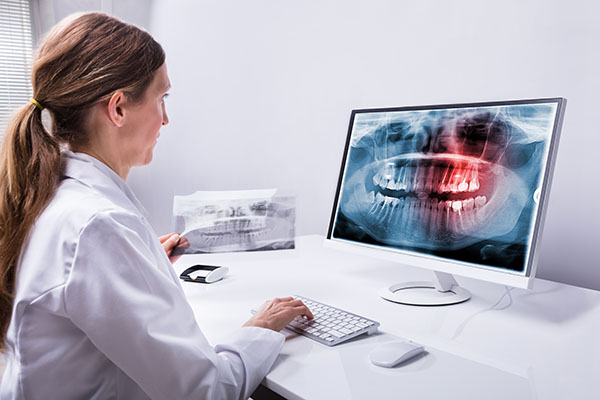
 With the advent of digital radiography, patients can now see their dental X-rays almost immediately when they are with the endodontist. X-rays enable the endodontist to see inside the tooth and determine whether your tooth requires endodontic therapy to solve its issues. Continue reading to know what the dentist will check for in an X-ray scan.
What an X-ray shows
When a dentist examines a patient's radiographs, they usually have a mental checklist of clues to note. This essentially means looking for deviations in the X-ray image from what is usual for a healthy tooth. These deviations might be so minor that they leave room for interpretation. Other times, the evidence is so clear that there is no doubt that the tooth needs root canal therapy. The endodontist checks for the following things.
Radiolucency at the periapical level
A black spot located on the tip of the tooth's root is one of the most evident indications on an X-ray that suggests that a tooth may need endodontic therapy. Dental professionals call this black area “radiolucency.” The lesion typically has a “hanging drop” look.
Other changes that might suggest that a tooth has endodontic issues
A ligament that surrounds the root of each tooth keeps it in place. This is known as the periodontal ligament, or "PDL," of the tooth. Any radiological alterations in the area occupied by the PDL or the surrounding bone to which it connects might indicate nerve issues within the tooth and the need for root canal therapy. If changes in the PDL and lamina dura show on an X-ray, then the patient needs endodontic treatment.
The periodontal ligament space is widened
If a part of the PDL gap appears to be expanding, this might suggest the onset of nerve tissue disease. When endodontic issues are present, this area expands as exudates (fluid byproducts) are produced by pulp tissue inflammation inside the tooth.
Differential diagnosis
Other factors that induce PDL expansion are sources of worry for dentists. These include a tooth with greater mobility, such as that which might occur due to tooth clenching. This habit can also lead to tooth sensitivity, which might be misinterpreted as a sign that endodontic therapy is required.
Changes in the dura mater
On dental X-rays, the surface layer of the bone socket that covers a tooth's root and to which the periodontal ligament is connected is seen as a white outline. The lamina dura is the name for this thick covering of solid bone. When sections of it look less visible or thicker on an X-ray, it might be an indication of the bone's reaction to the ongoing deterioration of the tooth's nerve.
Osteitis condensing
Chronic inflammation caused by pulpal disease might cause an extra bone to be deposited in the surrounding region of a tooth. Condensing osteitis is the medical term for this condition. On X-rays, this area shows as a diffuse white (radiopaque) zone because its density has risen due to increased bone tissue. It is typically located at the tip of the root of the tooth.
Final note
Seeing visible tooth-related pathology on an X-ray makes it that simpler to verify the accuracy of a diagnosis. The endodontist can also see signs of gum disease, cavities, large fillings, and the condition of past endodontic treatments in an X-ray.
Request an appointment or call Advanced Endodontic Therapy at 402-506-7111 for an appointment in our Omaha office.
Related Posts
For pain in your teeth, an endodontist is the right person to see for relief. This dentist focuses on the prevention, diagnosis, and treatment of infections that affect the nerve and roots of the tooth. Ignoring tooth pain or putting off an appointment can lead to further problems. To confirm that you have an abscessed…
Dentists often refer patients to an endodontist for root canal therapy to treat issues such as a tooth infection, dental abscess, severe tooth decay, and tooth damage. However, you can also visit an endodontist directly for diagnosis. This article highlights four signs that indicate a potential need for endodontic treatment.An endodontist can treat issues related…
An endodontist is a special kind of dentist who can treat damaged or diseased dental pulp. The pulp is the innermost layer of the tooth which consists of soft tissues, nerves, and blood vessels. An endodontist’s education goes beyond the four-year general dentistry program. The extra training that endodontists complete usually takes two to three…